What a generic calorie target asks of you
Your programme says 20 calories in 45 seconds, every minute on the minute. Enter your 2k and see what it should have said.
Written for everyone
20
calories
378 watts
1:38 / 500 m
1:38 / 500 m
Written for you
13
calories
223 watts
1:56 / 500 m
1:56 / 500 m
mm:ss — starts at the 45–49 average
A round number written for nobody in particular asks most masters athletes to hold a split faster than their own 2k race pace, once a minute, for ten minutes. Same power formula the Concept2 monitor uses, so the prescribed number is the number on the screen in front of you. The app does this for rowing, ski, bike, running, and every gymnastics movement — from five tested maxima.
See the test groupWhy I built Masters Engine
My name is Juho. I am not a coach. I am a mature athlete and amateur competitor who kept paying for masters programming I could not recover from — and I am not a beginner.
- 10th iF3 Functional Fitness Super Worlds 2024, Master Male 45–49 — on the leaderboard, under Master Male 45–49
- 91st Worldwide percentile, CrossFit Open 2024 — around the top ten per cent every year I have been able to compete. Athlete profile
- 7:07 2000 m row. The readout above deliberately starts slower than that, at the average for 45–49 — the gap is wider for most people than it is for me
Those programmes are competition cycles with the volume trimmed and an age bracket printed on top. An age bracket does not know how many hard days you can absorb in a week.
How Masters Engine differs from other masters programmes
Four days, shaped around recovery
Four training days, one session each, with an optional aerobic recovery day — not the five or six a competition cycle assumes from someone whose day is training. Every session arrives complete: warm-up included, built around that day's main movement, then the strength work and the conditioning, with every load, rep and calorie already worked out. Nothing to assemble in the car park.
Hard, easy, easy, hard. Heavy lower body and heavy upper body sit as far apart as the week allows, and deadlifts stay at deliberately low frequency. Most programmes append recovery advice to a plan; here it decided the plan's shape first.
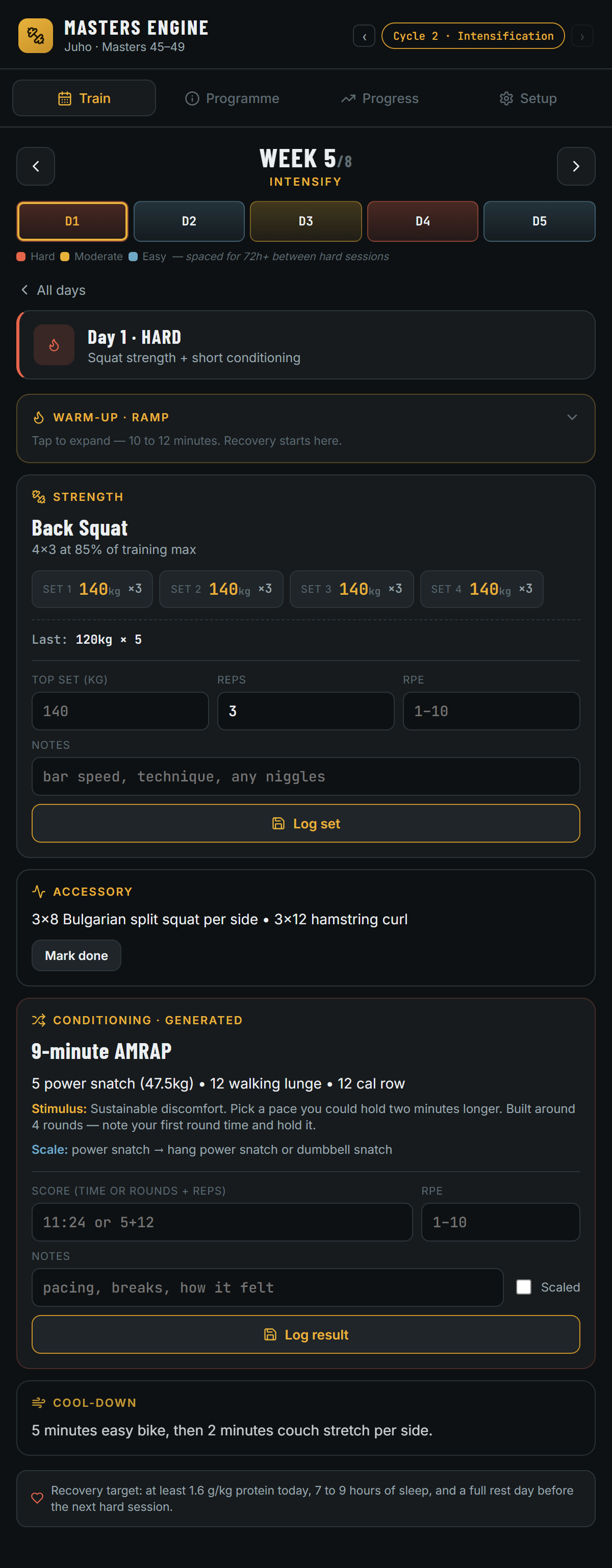
See the full example week, all five days.
Volume comes from your five capacity tests
2k row, 5k run, strict pull-up max, push-up max, hanging knee-raise max. Every conditioning calorie, metre and rep is a share of those. Two athletes on the same day get different numbers, and the session is dosed by work time rather than a rep count someone guessed. The whole calculation is written out, formulas included.
Training maxes move both ways — up, and down after a stall
Log your current strength and olympic lifting maxes and the sessions build on them. Once you get going, your maxes rise from the lifts you actually log, so the loads climb as you do. Then, when a lift stalls — target reps missed twice in a row — the app takes ten per cent off that max on its own, without being asked. Grinding through a stall is the likeliest way a programme injures somebody at 45+, and the reset is not damage control: it is the thing that keeps you climbing again in eight weeks instead of rehabbing for six months.
A competition taper is built in
If you have a competition coming, there is a built in competition taper you can activate. Enter the date and the programme peaks you into the weekend, gives you a plan for the competition days themselves, and walks you back out afterwards — and nothing you log across that window can drag your training maxes down.
There is no masters-specific taper protocol in the literature, so those numbers are reasoned from endurance and general-strength research. The reasoning is written out rather than presented as a finding.
Read more about the background of the programme and the app from Q&A.
The test group: 30 athletes, one eight-week cycle
I am looking for 30 masters athletes to run one eight-week cycle. This is a real test, not a waiting list, so the requirements are strict:
- You are 45 or over and train four days a week
- You know your training maxes
- You will test a 2000 m row before you start
- You will answer two questions a week: was it too much, or not enough
In return you keep free access permanently. If you have been coasting on someone else's numbers and do not want to test your own, this will not work — the programme has nothing to calculate from.
Ask for a place in the test group
One email when places open. Nothing else. How your details are handled.